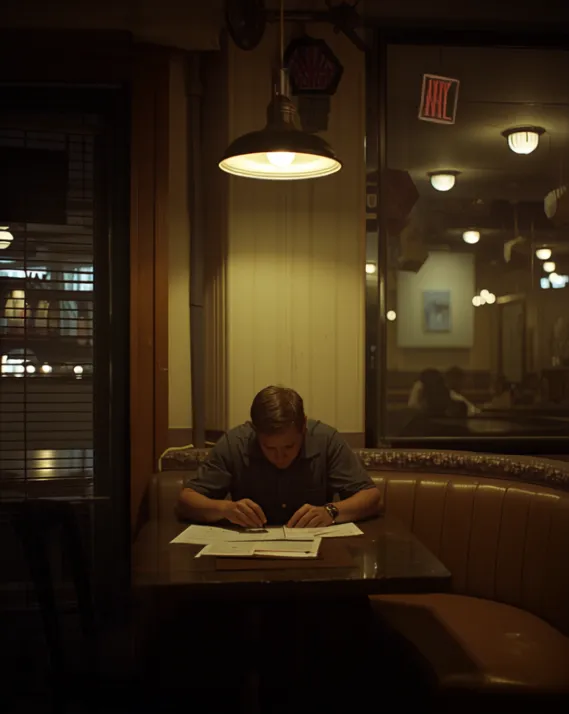
Nobody Has Time to Fix a Problem That Isn't an Emergency Yet
I read a LinkedIn post recently arguing that the restaurant and hospitality industry has an empathy problem.
Not from the people working in it. From the growing number of consultants, marketers, influencers and "experts" trying to sell something to it.
He's right.
Completely.
Restaurant operators are constantly being sold another solution. Another subscription. Another platform. Another marketing package. Another consultant. Another person explaining what they should be doing differently.
Meanwhile, the person being sold to has been at the restaurant since 6:00 AM. They covered a call-in, dealt with a broken piece of equipment, chased down a supplier, handled a guest complaint, approved payroll, and somehow still have to figure out why food cost climbed two points last month.
So yes. If you are going to sell something to this industry, empathy should be a prerequisite.
But there is another side to this conversation, and it is the harder thing to say.
Being too busy, too exhausted or too cash-strapped to deal with a problem does not make the problem go away. It usually just makes it more expensive.
Most restaurant owners I know do not need another person telling them to watch their numbers.
They already know.
They know labour needs another look. They know certain shifts feel overstaffed. They know food cost has been creeping. They have been meaning to re-cost the menu since spring. They have wondered whether portions have quietly grown over the years. They know comps, waste and overtime deserve more attention than they are getting.
The answer is almost never: "I don't care."
It's: "I'll get to it tomorrow."
Then tomorrow comes. Someone calls in sick. The walk-in goes down. The delivery is short.
A guest wants to speak to the owner.
The schedule needs to be rewritten.
Payroll has to go through.
Friday hits. Then Saturday. Then inventory.
Another week is gone.
Then another month.
Then a year.
Tomorrow was never coming.
That is not a character flaw. It is what the job actually is.
Imagine you know something isn't quite right with you. Nothing catastrophic.
You can still get out of bed. You can still go to work. You can still function.
So you tell yourself you'll book the appointment when things calm down.
But things don't calm down.
You're busy. You have responsibilities. People depend on you.
So you keep going.
Eventually, the problem you could have handled in a fifteen-minute appointment becomes the problem that puts you in the hospital.
Now you do not get to decide whether you have time for it.
And if you own a restaurant, there is a harder question sitting underneath that one:
Who runs the restaurant while you're in the hospital?
A restaurant can follow a surprisingly similar pattern.
A little labour creep is not an emergency.
Two points on food cost does not close the doors tomorrow.
A menu that has not been properly costed in a year can still produce sales.
Extra hours on the schedule, unnecessary overtime, inconsistent portioning, underpriced items, a bit too much waste. None of it announces itself. All of it hides in plain sight, and the restaurant keeps functioning right through it.
Until one day the owner looks at the bank account and asks:
Where the hell did all the money go?
The warning signs were there the whole time.
There was just never a Tuesday quiet enough to go looking for them.
Time is not the only problem.
When you live inside a business every day, you stop seeing it.
The way things are done becomes simply the way things are, long after it stopped making sense.
We've always scheduled six on Tuesday.
We've always portioned it that way.
We've always bought from that supplier.
That dish has always been priced there.
We've always given that away.
That prep job has always taken two hours.
Sometimes there is a perfectly good reason.
And sometimes the honest answer is:
"I don't know. We've just always done it that way."
That is where an outside set of eyes earns its keep.
Not because the person walking in is smarter than you.
They simply have not spent five years walking past the same problem until it became part of the scenery.
They can ask the question nobody inside the building asks anymore:
Why?
Take mozzarella.
In my restaurant, mozzarella is currency.
At our volume, being even one ounce heavy per order would cost us tens of thousands of dollars over the course of a year.
Not because anyone is stealing.
Not because somebody is trying to waste product.
Because one extra ounce does not look like a problem when you are standing on the line in the middle of service.
So we weigh every scoop. That might sound obsessive until you do the math.
An extra ounce here and there becomes pounds. Pounds become cases. Cases become thousands of dollars.
Then there is labour.
I had a sous chef who liked to clock in from their car in the parking lot.
Then they would come inside, put their belongings away, use the washroom and eventually report to the kitchen ready to work.
We had a conversation about what clocking in actually means.
Clocking in means reporting for duty.
It does not mean arriving on the property. It does not mean putting your coat away.
Twenty minutes does not sound like much.
At five shifts a week, that is roughly 86 hours over the course of a year.
That is more than two full 40-hour work weeks of wages paid for time before the work even started.
Essentially, an extra paid two-week vacation hidden twenty minutes at a time.
And here is the question I would ask every owner-operator reading this:
Can you even take a two-week vacation?
That is how these leaks work.
Nobody sounds an alarm over an ounce of cheese.
Nobody calls an emergency meeting over twenty minutes.
The restaurant keeps operating, so the problem gets absorbed into the business.
Then add in discounts that became too loose, waste that was never properly tracked, prep levels that no longer match actual sales, portions that drifted over time and employees clocking in before they are ready to work or clocking out long after the work is finished.
Individually, none of them looks like the thing that is going to hurt the restaurant.
Together, they can represent tens of thousands of dollars a year.
There usually isn't one giant hole in the bucket. There are twenty little ones.
This is where a lot of consulting goes wrong.
An exhausted operator does not need somebody walking through the door and creating another job for them.
Not another dashboard to check every morning.
Not another platform to learn.
Another login.
Another weekly meeting.
Another binder.
Another spreadsheet.
Another list of 47 things they're apparently doing wrong.
If I walk into your restaurant, hand you a mountain of work and leave you busier than I found you, I have not solved your problem.
I have added to it.
The goal is not to identify everything that could theoretically be better.
Any consultant can produce that document, and it will probably be technically correct and completely useless.
The goal is to find the handful of things that actually move the numbers, tell you what they are worth, and make the fix simple enough that it survives a Saturday night.
What is costing money right now?
What can be corrected?
What is the return?
What can we make simpler?
Everything else is noise.
I have never liked that phrase, particularly when it is aimed at an operator whose margins are already squeezed.
It is remarkably easy to tell someone they need to spend money when it is not your money.
So here is a better question:
How do we make the money you're already spending work harder?
If a restaurant is doing $100,000, $150,000 or $200,000 a month, there is an enormous amount of money already moving through that business.
The question is not always how to get another $20,000 through the front door.
Often the better question is how much more of what is already coming through it you get to keep.
One point of food cost.
One point of labour.
Better purchasing.
Better scheduling.
Correct portions.
Less waste.
Smarter menu pricing.
None of that is glamorous.
None of it is getting a million views.
But at $150,000 a month, one point is $18,000 a year.
And if the fix holds, that $18,000 does not disappear next month.
It keeps paying you.
Revenue is what people brag about.
Profit is what keeps the lights on.
This is where the people selling to this industry, myself included, have to hold ourselves accountable.
When I ask an operator to pay me $2,500 for a Profit Audit, I need to be clear-eyed about what that $2,500 actually represents.
On my invoice, it is a consulting fee.
To the operator writing the cheque, it is $2,500 that could have gone somewhere else.
It is a supplier payment.
An equipment repair.
Part of payroll.
Rent.
It might even be the first real money an owner has had available to take home in months after leaving everything else inside the business.
So my objective cannot simply be to sell a $2,500 audit.
My objective has to be to go find considerably more than $2,500.
Find the labour leak.
Find the purchasing problem.
Find the menu item that sells all day and contributes almost nothing.
Find the portion creep.
Find the operational habit everyone stopped questioning in 2019.
Find the money that is already moving through the restaurant and somehow never reaches the bottom line.
The invoice is not the deliverable. The return is.
The original post was right.
This industry does not need more people on the sidelines telling exhausted operators everything they should be doing.
It does not need more gurus.
It does not need more theory.
And it definitely does not need people who have never worked a service treating a twelve-hour day as a failure of time management.
Understand the operator first.
Understand the margins.
Understand the pressure.
Understand that when someone says, "I don't have time," they may mean they have nothing left to give today.
But empathy that stops at sympathy is not help.
The operators who most need time to work on the business are often the exact ones with none, because they are buried working in it.
Telling them you understand changes nothing.
Going in and finding the money does.
Not someone arriving to explain how badly you have been running your restaurant.
Someone willing to stop, look at the numbers, ask the questions you have not had time to ask, challenge what has become normal, find where the business is bleeding, and help fix it while it is still a Tuesday problem and not a hospital one.
There is never going to be a perfect time to work on the health of your restaurant.
Eventually, the business picks the time for you.
A Profit Audit is not another subscription, another dashboard or another piece of software you have to remember to log into.
I go through the numbers that already exist inside your business: your P&L, POS data, invoices, schedules, labour, purchasing, food cost and operating habits.
Then I come back with what is leaking, what it is costing you, what it could be worth annually, and what to do about it.
Ranked by what is worth the most and what is easiest to fix.
Not 47 things.
The few that matter.
You do not get another login.
You do not get a mountain of homework.
You get a number, a short list and a clearer picture of where your profit is going.
If you're reading this at 11:30 at night because it is the only quiet hour you got today, that is the entire point.